Tuesday, August 03, 2010

Dead Again/Born Again: Reincarnation Bollywood Style

Deepika Padukone & Shah Rukh Khan
 in Om Shanti Om
Image: Eros International
Abandoned ruin, palace, Rajasthani desert, or some such combo? Blurry visions, inexplicable dreams, and blackouts? Recurring melody? Forbidden love? Check, check, check, and check.

You must be in for three hours of déjà vu Bollywood style, otherwise known as the quintessential reincarnation story.

Even though seasoned Bollywood watchers can spot the signs well before one of the leads first blacks out to an annoyingly catchy recurring melody from their past, we can't seem to pull ourselves away from the screen until the two lost lovers find their way to each other again. I mean, they travelled through time, fought with destiny, and by some freak genetic mutation managed to look exactly the same just to be together, the least we can do is watch as they vanquish the villains (sometimes thakurs, often long-haired and/or moustachioed) that separated them in the first place and sob while they reunite for generations to come.

Karzzz (2008) A Reincarnation of Karz (1980)
Image: Bollywood Hungama
Tongue-in-cheek aside, the caricatured nature of this genre became more prevalent in its modern-day remakes like Karz (and yes, Karzzz, sigh), thought to be inspired by The Reincarnation of Peter Proud, itself thought to be inspired by Madhumati (the tangled webs we weave), Prem (Tabu-Sanjay Kapoor), Hamesha (Kajol-Saif Ali Khan), Ab Ke Baras (Amrita Rao-Arya Babbar), and the blockbuster Om Shanti Om to name a few (there was also a low-budget film with now-TV host Pallavi Joshi called Mangni if you can remember it!). The original precursors to these spoof-like films toyed with the psychologically thrilling aspects of the stories and had some genuine mystery and intrigue.

Madhubala as the hauntress in Mahal
I
mage: www.chandrakantha.com
The 1949 Mahal, directed by Kamal Amrohi and starring Ashok Kumar and an esoteric Madhubala is credited as being one of the first films to deal with the subject. The film is best remembered for its haunting music ('Aayega Aane Wala') and moments of genuine psychological wrestling and angst for Kumar as the protagonist. Similarly, a decade later, Bimal Roy's Madhumati (1958), who incidentally edited Mahal, was an instant cinematic success. It not only captialised on the famous Dilip Kumar-Vyjayanthimala chemistry but had the audience guessing until the end with some plot devices which may seem cliched now but were novel for the time. In fact, Om Shanti Om's similarities to Madhumati were so clear that Roy's daughter was reportedly suing the producers, Red Chillies Entertainment (headed by Shah Rukh Khan and his wife, Gauri Khan), for infringement of intellectual copyright and plagiarism.

Over the years, some directors altered the tried and trusted formula with varying degrees of success. The Rishi Kapoor-Sridevi starrer, Nagina, relied on the audience not only believing in reincarnation but also in the ability of female cobras to morph into humans at will, avenge their mate's death, and recognise their souls in human form. Seriously. I don't have that good an imagination to make that up. Oh, and in case you were wondering and slept through the mid-1980s, yes it was a hit and there is, brace yourselves, a sequel (Nigahen).

When all is said and done, if you feel you need to justify the three hours as more than just brainless fun, you can cock up some story about better understanding the depiction of the teachings of Hinduism or Buddhism through popular culture or the social psyche of a people's attitudes to death, life, and human existence.

Frankly, I just watch them for the marked costume changes between the two lives and call it a day.

Monday, July 19, 2010

Turko-Baba a la Bollywood Baba

The other day, while taking a public transit bus on holiday in Istanbul, my light snooze was interrupted by the blaring of the catchy 'We Twist' from Love Aaj Kal on the local radio station.

Deepika Padukone and Saif Ali Khan
Image: bollywoodmantra.com
Suddenly, the sapera leitmotif throughout the remixed version of the song I rather like, took on a new flavour and a stereotypical image of harem concubines serenading a sultan in the inner quarters of a palace jumped to mind. And, just as another foot tapping oddly Arab-sounding chord of the chorus played on, it all seemed to fit maybe better in Istanbul than in Indore.

It got me thinking.

While we shouldn't be surprised that all things 'Bollywood' are crossing more oceans and countries than before, it seems that young new directors are wise to markets beyond the usual suspects (e.g. NRI communities in places like Canada, the US, and the UK). In fact, given the growing disillusionment with standard Bollywood fare in much of India and among the usual suspects, these newer markets might be the only way forward to keep the magic of Bollywood alive.

Anyway, have a listen and tell me which market you think they're targeting, Istanbul or Indore? http://www.youtube.com/watch?v=KgmeL_xuB0I

Thursday, June 10, 2010

Kabhi Alvida Naa Kehna: 'Good-bye' didn't come soon enough

*Cautionary note: This was the film that put me over the edge and prompted me to stop blogging about Hindi films for so long. A previously unpublished post from 2006, read it with 'retrospect' in mind.*


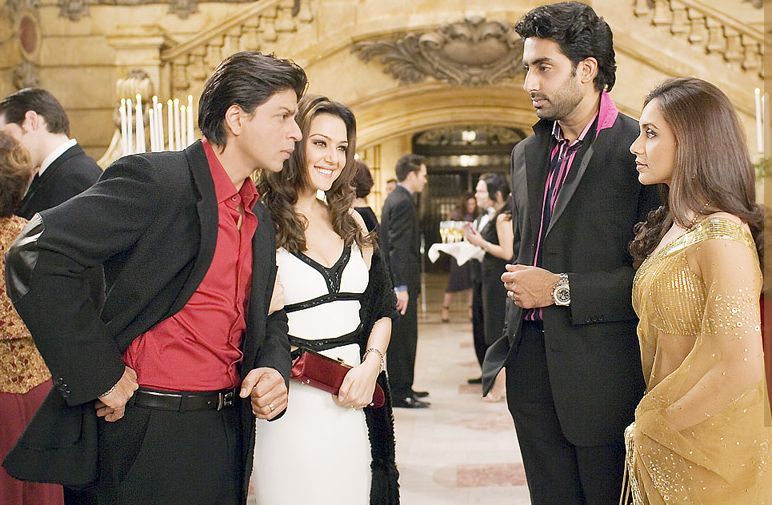
Shah Rukh Khan, Preity Zinta,
Abhishek Bachchan, Rani Mukherji
Kabhi Alvida Naa Kehna (2006)
Image: pinkvilla.com
That Karan Johar gives his audience little credit comes shining through in this nearly 4-hour celluloid magnum disappointus.

Kabhi Alvida Naa Kehna (dubbed KANK by filmi acronym enthusiasts), does nothing but confirm suspicions that Johar fancies himself a Robert Altman but blatanlty lacks the talent or originality of the senior director.
Relying heavily on his almost incestuous connections with Bollywood luvvies, Johar unsurprisingly reeled in an all-star cast with Shah Rukh Khan, Rani Mukherji, Abhishek Bahchan, and Preity Zinta as the leads, and Amitabh Bachchan, Kirron (that's how she's spelling it these days) Kher, and Arjun Rampal as the supporting cast. Resorting to cliched 'spot the star' cheap thrills, Kajol and John Abraham make brief appearances in two all-thumpy no funky songs.

The story centres around the tumultuous relationships of two not-so-happily married couples, Dev Saran (Khan) and his wife Rhea (note the Americanised spelling here) (Zinta), and Rishi (Bachchan Jr.) and Maya Talwar (Mukherji). To make a much-in-need-of-editing film short, all four characters have certain issues that they can not solve within their respective marriages, leading Dev and Maya to seek solace and comfort in each other.

Seems like an opportunity to delve into the darker side of cotton candy romance, doesn't it? Well it is. Sadly, this movie does not deliver on Johar's loudly asserted promise.

Despite the inordinately long time the film has to let the audience engage with the characters, they appear as little more than cardboard cut-outs throughout.

Dev, a disgruntled former soccer star, remains disgruntled, humourless, and unneccessarily mean to his son Arjun; no real explanation is gleaned as to why Maya constantly feels inaduequate despite her husband's overt attempts at love; Rhea's gung-ho 'all work no play' attitude is taken to extremes presenting her as a one-dimensional working mother; and Rishi who is presented as 'child-like' throughout, really does nothing of the sort.
The most unique and believable relationship in the film is the sweet and spunky friendship that develops between Dev's mother, Kamaljit (Kher), and Rishi's father, Sam/Samarjit (Bachchan Sr.). Sadly, the film's treatment of this and the other relationships is as superficial as the glitz in every reel.

The shortcomings are not because the script, largely written by Johar, relies on subtlety--in fact, at times it is so cumbersome that the audience wishes for the opportunity to read between the lines. The script simply does not build on what could have otherwise been a rather meaningful film.

Instead, Johar indiscriminately relies on cliches from his own and mentors Yash and Aditya Chopra's previous celluloid melodramas to weave thin attempts at humour and depth. KANK resembles, in no small measure, a not-so-cheap knock-off of
Silsila with a sleeker look. Slight changes to the central plot and the now requisite shift of scene from Bombay to New York common to every second film these days is all the credit Johar can take.

In fact, since Johar so vehemently tried to ward off accusations of what can only be labelled intellectual/artistic property theft, one wonders why two classic scenes from Silsila were left blatantly unedited from the final cut.

I refer to: (1) the hospital scene in Silsila when Rekha presents Ambitabh Bachchan with a bouquet of red roses: 'Khamosh ho ke bhi phool apne rang or khushboo se bahut kuch keh jaate hain' and (2) watching his wife Rekha dance with Bachchan, Sanjay Kumar says to Jaya Bachchan: 'Aise lagta hai ki angrezon ne dancing ka doosre lagon ki biwiyon ke saath naachne ka achchha bahana hai.'

Both scenes are almost identical in KANK, with Abhishek Bahcchan echoing daddy's words 25 years later in response to a red rose he mistakenly assumes Rani Mukherji brought home for him, and Shah Rukh Khan aping Kumar's words but substituting 'dancing' for parties while Bachchan Jr. obliges Preity Zinta in a PR-do.

Wednesday, June 09, 2010

Back to 'work'

I think the run of some truly mind-numbing films over the last few years took its toll and killed the will to continue with the blog. While the mind-numbing nature of many of the films released over the past four years hasn't changed much, the desire to comment on them has certainly been reignited. Why? I think my anger issues will probably receive a much more enthusiastic response if I comment on the hilarity of the always present white-sari-in-the-rain scenes than on contemplating new ways of using that never-ending piece of fabric for other means.

Sunday, February 26, 2006

Neal 'n' Nikki- yuk 'n' yukky

Tanisha Mukerjee and Uday Chopra
Image: yashrajfilms.com
When is Uday Chopra's daddy dearest finally going to have the strength to burst his 'tiger's' bubble and get him off the screen? 

In yet another attempt to launch the struggling wanna-be star, Yash Chopra's production house, Yash Raj Films, produced Neal 'n' Nikki, relying more on Tanisha Mukerjee's ample cleavage than Chopra Jr's limited 'talent' to draw in the crowds. That Baby Chopra would have been pestering big brother Aditya to produce this all-gloss no momentum film is pretty apparent--the poor man had to rip off his own classic, Dilwale Dulhania Le Jayenge, to massage kid brother's delusions of grandeur.

The story is of the typical boy-meets-hates-loves-girl variety.

Neal (Uday Chopra) is set to marry Sweety from Punjab in 21 days and begs his father for his last singleton days to be bachelor heaven in Vancouver. (Sound suspiciously similar to Simran in DDLJ?) This is where he meets Nikki (Tanisha Mukerjee) and you can fill in the blanks.

Half the length of DDLJ, it follows half the story centring on the coming-of-age road trip (substitute British Columbia for Europe), with definitely less than half the oomph. There's even a scene where they parody the famous Simran running-in-the-sarson-fields scene towards Raj.

Lacking originality in plot, this movie sold itself on two main novelties: (1) that it was shot in BC and (2) it dealt with pre-marital sex. But this is where they went wrong.

Neal 'n' Nikki is not the first or only film to be shot in BC: Aap Ko Pehle Bhi Kahin Dekha Hai, Mohabbat, and Shakti (to name a few) have been there and done that.

As for pre-marital sex,we don't have to look further than Yash Raj Films itself to see that not only is it currently Bollywood flavour of the month (Salaam Namaste) it has had a long and intimate history with Indian cinema (Dhool Ka Phool, Deewar, Silsila).

So what exactly does this film offer?

1. An insight into Indo-Canadians? NO.

The first scene opens with Neal, supposedly born and bred in Canada, describing himself (in English) as a typical 'Indian guy who's never been to India' in the thickest Indian accent you have heard. There's nothing wrong with an Indian accent, but how prey tell, does a Canadian dude from small-town Oliver, BC acquire it when he's never even stepped foot in the pind? Ditto for Nikki.

It raises further questions about authenticity when the two real-life Indo-Canadian extras playing Neal's best friends talk to him with the local Canadian accent (as one would expect). We're left wondering if was Neal raised in a vacuum watching only Mumbaiya Hinglish TV.

Question for the director, Arjun Sablok: What was the point of Uday's blue contacts?


2. A timeless and exquisite love story? NO.

The chemistry between Chopra and Mukerjee could put a damper on a puddle. This is hardly surprising since Nikki's only character development rested on how successively short her skirts could get with each passing scene, and how many bras she could pass off as tops.

The particularly yukky moments came during the excruciatingly long slobbering lip-locks. Aside from the handicaps in their actual kissing technique (maybe some coaching and a box of Kleenex would have helped), given the lack of any real emotional bonding between the characters it reeked of a transparent ploy to rake in an audience. God knows, it had next to nothing else.

3. A showcasing of new and budding talent? HELL NO.

The biggest indictment here is that for the first time in any of his films, Chopra was not the most annoying among the cast. That prize had to be given to Mukerjee hands down.

Openly imitating some of big sister Kajol's tactics, Tanisha embodied all of her annoyances with none of the saving graces. Either that or she played the character of Nikita Bakshi a little too convincingly. I lean heavily towards the former.

A little thought to ponder: isn't it interesting that Uday's 'stardom' is limited to in-house productions by Chopras' chamche? It's telling when the owner and star-director of the self-professed 'number 1 production house in India' won't take his own son in any of his centre stage productions.

If he's not good enough for them, I wish they would stop inflicting these all-style-no-substance hacks on the rest of us.

Thursday, February 23, 2006

Maine Pyaar Kyon Kiya- WHY indeed!

Granted, David Dhawan is not known as a great provider of thought-provoking and symbolic cinema, but in Maine Pyaar Kyon Kiya he fails to meet even his own low standards.

That this three-hour ordeal was nothing more than a paid Khan family vacation to the Maldives and Dubai (with girlfriend Katrina Kaif and brothers Sohail and Arbaaz Khan in tow), was evident as plot was traded for glossy sets and frolics on the beach. You half-expect step-mother Helen to wiggle out from behind a palm tree firmly grasping father Salim's hand. If only.

The 'story'
centres on the philandering ways of a supposedly 'young' 30-something orthopaedic surgeon, Sameer (Salman Khan), whose string of girlfriends are kept at bay by constantly lying that he his married. This works until he falls in love with Sonia (Kaif), and wants to marry her.

Having willingly had an affair with a supposedly married man, Sonia suddenly develops a set of scruples and harasses Sameer (while annoying the viewers) to meet his supposed wife.
Sameer enlists his nurse Naina (Sushmita Sen), who is secretly in love with him, to play said biwi. (Well, of course, what 5' 10" nurse with model looks would not fall for a 5' 4" doctor with a receding hairline who molests his female patients and lies to his girlfriends?)

To make a long, annoying, and predictable story short, the lies escalate until Sameer's staged divorce with Naina is halted by his mother who rides into the courtroom as soon as she steps off her train from Patiala (or some such place) after he delivers the line, 'What do we expect from our wives? That they're like our mothers in the kitchen and our girlfriends in the bedroom'. One wonders if Salman found it easy to slip into this method acting after years of real-life experie
nce...

After an elaborate homecoming of the newly non-divorced couple, a series of Binduesque behaviour is adopted by Naina to make
saasu-maa beg Sameer to get a divorce after all. All the while, Sameer is secretly seeing Sonia who is also being wooed by her neighbour, Pyaare (Sohail Khan).

And yes, you guessed it. There is a jilted-at-the-alter finale (Sonia leaves Sameer for Pyaare) which wouldn't be complete without a stop-the-plane airport scene (Sameer is urged by best friend, Vikaram or Vijay or V-something (Arshad Warsi) to get Naina back).

The airport scene confirmed that the quickly dwindling number of unstolen Hollywood scenes has caused some directors to turn to television. I am speaking of the final episode of
Friends where Phoebe stops Rachel's plane to Paris by scaring people into thinking something was wrong with the 'left magwheel'.

Ditto. Insert Naina for Rachel, Sameer for Ross, and V-something for Phoebe. Of course, why Naina would take the call of V-something at all, a man whom she despised so much that she had to leave the room to wash her hands every time he touched her, remains among this movie's many mysteries.

All the usual disclaimers about Salman Khan's 'acting' apply. He can barely deliver a line without contorting his face, his contrived deep voice squeaks to belie its high pitch, he's bare-chested at least once a reel, wears high-heeled boots to appear taller than both female co-stars, and postures throughout.

Most telling about the quality of this film is that despite all of this, his acting 'ability' out-scrapes Sohail Khan's. Blessed with even fewer looks and talent, Sohail joins Salman in flexing his muscles throughout. Someone should really tell him to stay behind the camera--but then again, perhaps this is why he finances his own films.

Why we are forced to endure a 40-something has-been actor turned fatal hit and run driver, poacher, and woman-beater who displays his steroid induced body for self-propagated voyeurism on the screen, is really the question. Sadly, this film does nothing to counter that.

Sunday, January 08, 2006

Dosti - this film's no friend to cinema

Deol, Dutta, Kapoor, Kumar in Dosti
Image: BBC Shropshire Entertainment website
So Hindi movies have got slicker and sharper than the pitiful efforts churned out in the 80s? Think again.

While Akshay Kumar and Bobby Deol are never going to win serious acting awards, with Kareena Kapoor and Lara Dutta added to the cast, you would think that the end product would be less torturous than the 136 minutes of brutality Dosti turned out to be.

One of the main problems is the film is not sure what it's supposed to be - comedy, romance or family melodrama? Trying to fit in all three fails disastrously.

Subtlety is at a premium from the opening sequences as Karan Thapar (Deol) is neglected preposterously as a child by his busy parents, played by Lilette Dubey and Kiran Kumar. In an early scene, young Karan storms out and kicks his football from their farm, bearing a striking resemblance to a city mansion, towards the Himalayas! He slips down the ravine but is rescued when the ever originally named, Raj Malhotra (Askhay Kumar), appears from nowhere. 

So the two friends become adults in Chandigarh (while the parents haven't aged a day), which the film claims is right next to Gurgaon (in fact hundreds of miles away). In one of the scenes (visibly filmed in Shimla) the number plates are so fake it seems they're painted on planks of cardboard. Despite these glaring issues, there's nothing early on to suggest this will be anything worse than an average flick. When Anjali (Kareena Kapoor) is introduced as Raj's love interest and the playboy Karan pursues Kajal (Lara Dutta), there are even some moments of genuine humour.

But then it all goes wrong. 

Both weddings are called off as hastily as they are arranged. Anjali is married off within hours, and Raj is diagnosed with an incurable bone marrow problem. In his final days, Raj decides to bring Karan's family together and get his marriage with Kajal back on. Achieving this is ridiculously easily.

In quite the farcical finale, we are told there is a cure for Raj's problem but there's no point flying to the US to save him.

Despite seeing his life squeezed out by the minute, Raj frolics away with his doctor at Karan's wedding until an epileptic seizure (is that a symptom of bone marrow disease?) precedes a predictably emotional climax.The final scene sees Karan celebrating his businessman of the year award despite never working a single day.

When you stop drying the tears of laughter streaming from your cheeks, you might go away thinking it's the script and plot which are diseased in this film more than any of the characters.

Monday, January 02, 2006

Shikaar - someone should hunt down Jas Pandher

If you saw Indian Babu and went away safe in the knowledge that it would surely end the career of Jas Pandher after only one film, we have bad news for you!
His father Surinder (owner of Southall-based Himalaya Carpets and Himalaya Palace Cinema, and a one-flop disaster himself in the 60s) has bankrolled a second successive shocker.

Jas Pandher plays Vijay Sanyal, whose bank manager father is murdered at the start of the film by head villain Damania (Danny Denzongpa) and his associates - and not a moment too soon after an abject performance where he struggles to remember his lines!

In the scene where he is shot, the father slumps to the floor, apparently dead. But near the end of the film, when the story is recapped, he is shown staggering back home to reveal the identity of his killer to his son - who then runs off, after his mother has also collapsed and died, leaving his sister stranded.

Or so you think...

Having grown up to become a car thief - while none of the villains aged a single day - Vijay begins his 'shikaar' by enticing his targets to Mussorie where he plans to sell them a hotel he takes over after marrying Madhu (Kanishka).

One by one Tej Sapru, Shweta Menon, Shakti Kapoor, Ashish Vidhyarthi, and Prem Chopra (who plays Nikhil Chopra, 'Son of Prem Chopra' - the joke wears thin after one mention) are knocked off by a mysterious killer - who looks uncannily like Vijay.

It looks a straightforward case for the amnesiac cop played by Raj Babbar - but lo and behold the climax reveals the killer to be his sister, played by Saadhika.

As you may have gathered, the plot has gaping holes in it, while the script is laughable. The soundtrack is lame and songs are erratically woven in to fill the huge vacuum.

Pandher's acting is non-existant - he rarely takes off his sunglasses in the movie, an attempt to hide his expressionless face, while he tilts his head from side to side and raises his eyebrows while 'delivering' his lines.

Apart from the guy who plays his father - who could very well be his off-screen dad - the other actors aren't too bad. In fact you have to feel for poor old Danny, who must be wondering what he let himself in for.

It's not the worst film we've ever seen - but it's not far off - and hopefully this is the end of Jas Pandher's career.

You could say it got as a good as it could for him when he starred in a commercial for his dad's shop and, arms outstretched, uttered the immortal line: 'We sell carpets, sofas, tables, chairs and furniture too!'

Monday, November 28, 2005

Hollybolly - hit or miss?

Have you seen a truly dreadful Hollywood or Bollywood film and been left in stitches by the sheer incompetence of it?

We regularly witness such shambles and there is a perverse pleasure to be gained from sitting through anything from 1.5 to 4 hours of it!

We will highlight particularly dire displays of cinematic incompetence here and invite you to add your comments.