Tuesday, October 26, 2010

Moonstruck: Bollywood's Gaga Over Karva Chauth

The moon, a sieve, some sindoor, and a husband (or someone close enough). Everyone's gaga over Karva Chauth, Bollywood style.

Aishwarya Rai anticipating Karva 
Chauth, Hum Dil De Chuke Sanam
The depiction of numerous Karva Chauth scenes in Hindi movies since the mid-1990s has popularised the festival to such an extent that, according to local reports, it's being observed in parts of India which didn't have a history of practicing the tradition. Once mainly common in Punjab, Uttar Pradesh, and much of the Hindi-speaking belt, its spread is being felt in places like Maharashtra, West Bengal, and even the south, promising something for everyone including the cynics (for the latter to ponder: it's now a Hallmark holiday in India known as Husband's Day--I am not kidding I bought a card as evidence).

So, how have Bollywood movies transformed Karva Chauth? (A word of warning to feminists to stop holding their breaths. They do not question traditional assumptions of patriarchy and marriage--but then did you really expect them to?)


1. Fasting all day without so much as a sip of water makes one radiant (and so should you) 

A saas-bahu Karva Chauth moment
Hema Malini & Rani Mukherji, Baabul
Perhaps it's the special glow of the moon, or maybe their skin glistens as they break out in a cold sweat having fasted all day. Whatever it is, the women gather up the stamina to doll themselves up and look gorgeous. The guys on the other hand, tend to stagger in for the pooja either in run-of-the-mill white pyjama suits or their work clothes (Yes Boss, for example). They are, after all, bringing home the bread--we shouldn't expect much. Notable rays of Karva Chauth radiance come to mind in the form of the ever-stunning Aishwarya Rai as she recollects her past in the song, Chand Chhupa Badal Mein (Hum Dil De Chuke Sanam, 1999), and (even I am shocked at myself as I write this) a rare show of non-sluttiness by Shamita Shetty in the song, Agar Tum Mil Jao (Zeher, 2005), as she serenades Emraan Hashmi (eww) on the auspicious day. Hema Malini and Rani Mukherji as the fasting saas-bahu duo in Baabul (2005) looked perfectly decked out having their last meal at 4 am, a time better suited to fuzzy slippers and crumpled robes than solah sringaar.

2. It's the ultimate form of romance especially if it's on the sly (Nothing says, 'I love you', like hypo-glycemic shock.)

The perfect Karva Chauth ruse
Shah Rukh Khan & Kajol
 Dilwale Dulhania Le Jaayenge
As with all else filmi, Bollywood has succeeded in capturing the cotton candy side of what is considered to be one of the most difficult and pious fasts in the Hindu tradition. To be fair, it is what we watch these movies for. Aditya Chopra's modern classic Dilwale Dulhania Le Jaayenge (1995) (DDLJ) is largely credited with propelling Karva Chauth into the modern-day psyche as the ultimate test of romantic love.  It's probably helped by some rather mushy (which I must admit, I love) scenes between Simran (Kajol) and Raj (Shah Rukh Khan), and the annoyingly catchy tune set to the recurring melody of Ghar Aaja Pardesi. Who can forget the scene when Raj likens Simran to the moon by pointing to her reflection in a mirror, or the late-night rooftop rendez-vous when Simran insists that Raj feed her the first bite of food and give her the first sip of water to break her fast, culminating in her fake-out fainting in front of everyone? Reprising the theme eight years later, Ishq Vishk (2003), also built on the starve-for-your-secret-love theme and included a scene with Payal (Amrita Rao) fasting for her best friend-turned beau, Rajiv (Shahid Kapoor), who sneaks into her bedroom so she can perform the pooja.

3. If he really loves you, he'll fast too. (Aww... now the two of you can rest in adjoining cots strung up to a joint glucose drip.)
Stolen Karva Chauth moments
Shah Rukh Khan & Kajol in DDLJ

We have DDLJ to blame for women everywhere feeling crappy if their husbands/significant others don't at least feign to fast with them on Karva Chauth. I found the surprise fast in DDLJ by Raj ending with a secret Karva Chauth meal on the rooftop utterly endearing. It's become so much the politically correct thing to do in Bollywood, that real life superstar husbands, Askhay Kumar and Abhishek Bachchan, claim to be fasting with their wives, Twinkle Khanna and Aishwarya Rai Bachchan, respectively, and compel those who cannot to provide a reason why (see Amitabh Bachchan's tweet T-166).

Amitabh Bachchan & Hema Malini
in a happier Karva ChauthBaghban
The reciprocal fasting in Baghban (2003) between a senior (yet very unoriginally named) couple, Raj and Pooja Malhotra (played by Amitabh Bachchan and Hema Malini), on the other hand, made me nauseous. But then again, there was many a nauseating moment in this film. For one, it is unbelievable that even in the modern age, Raj Malhotra's daughter-in-law (or her servants) who is also fasting, would not have arranged to have any cooked meals made for the evening. Equally unbelievable is that his son, daughter-in-law, and grandson would have left him alone at home with no food (knowing that he fasts) while they chow down at some restaurant after the pooja. And of course, the ultimate level of disbelief came when the only thing the two perfectly healthy and active seniors could do was cry into the phone and sing pathetic songs rather than arrange to have met on what was made out to be the most important day in their lives.

4. If you're not married, fast for the guy you want. If you don't get him, treat it as a dry run for the guy you end up with.

Aishwarya Rai & Abhishek Bachchan's
first Karva Chauth
Dhaai Akshar Prem Ke
Even though keeping the Karva Chauth fast if you are unmarried is a strict no-no and wouldn't be condoned in most families, romance prevails. The most common justification for showing unmarried couples or hopeful singletons keeping the fast is that by doing so, you will get the guy... forever. Notable fasting singletons include Kareena Kapoor for Hrithik Roshan in Kabhi Khushi Kabhie Gham (2001), ironically, Aishwarya Rai Bachchan's first Karva Chauth for Abhishek Bachchan in Dhaai Akshar Prem Ke (2002), and of course, Kajol for Shah Rukh Khan in DDLJ.

The not-so-happy Karva Chauth
 Ajay Devgun & Aishwarya Rai
Hum Dil De Chuke Sanam
Of course, where the unmarried Karva Chauth wish is proved wrong, like in Hum Dil De Chuke Sanam, we can take solace in the fact that the leading lady already had practice pre-empting any embarrassing fainting spells in front of the in-laws... though a smile would not go amiss.

5. There's only one way to celebrate Karva Chauth... the Punjabi way... oh, and there will be dance!

The homogenised depiction of what were and, for the most part still are, extremely varied regional and community-based Karva Chauth practices all go one way (much like everything else in Bollywood). The practices of sargi (a special set of offerings for the bahu by her mother-in-law) which was popularised in Kabhi Khushi Kabhie Gham, looking at the moon through a sieve and then capturing your husband's image in it, and the passing of the pooja thali around a circle in a group of women are largely all Punjabi customs.

A family Karva Chauth
Kabhi Khushi Kabhie Gham
There is nothing wrong with this but some variety (especially, when the lead characters are not Punjabi, as was the Gujarati Nandini in Hum Dil De Chuke Sanam) would quell some of that KC déjà vu. Mostly though, rather than succumbing to dizzying headaches, our main characters rejoice in fast-paced twirls and group dances à la Bole Chudiyaan in K3G and Mera Mahi in Dhaai Akshar Prem Ke.

Happiness isn't happiness without a healthy dose of love and starvation.

Thursday, September 30, 2010

Love and Arranged Marriage: back off Hollywood, Bollywood does it better

Toh Baat Pakki? Damn straight... Because I Said So!

Who said marrying off your youngest daughter to the first eligible suitor was just a Bollywood hobby restricted to strict (for some reason always Punjabi) fathers and helpless (often ill/widowed) mothers?

The other day, on a night I really should have bothered to go out, I was flicking channels while home alone and came across, Because I Said So (2007), a movie of the out-on-DVD-in-two-weeks variety starring Diane Keaton, Mandy Moore, and no one else I care to remember.

Now, normally the thought of spending 90+ minutes watching Diane Keaton don the same white palazzo pants suit she has over the last 30 years (seeing her in a dress in The Godfather seriously destablised my chakras) would have been enough to keep right on flicking, but the plot line seemed much too retro-Bollywood to pass up.

Moore, Graham, Keaton, Parabon
Because I Said So (2007)
Image: http://movies.nytimes.com/2007/02/02/movies/02beca.html
Unbeknownst to her youngest daughter, Milly (Moore), Daphne Wilder (Keaton) takes out a personals ad to find her a husband. She finds not one, but two potentials. Yes, you heard right--old school, arranged marriage tactics.

We aren't entirely sure what compelled Daphne to do so other than her own assessment that Milly was on the path to spinsterhood because of her current lack of boyfriend, and that, in a nation where 50% of marriages end in divorce, her own failed marriage somehow left Milly deeply emotionally scarred (she overlooks the fact that her two older daughters seemed to have come out OK, and yes, miraculously were able to get married).

Milly displays no obvious or subtle personality disorders. Being in her 20s she is certainly not over the hill, is generally cheerful, and the sole neuroses she seems to have to deal with on a regular basis come from the general direction of her mother. I leave you to fill in the blanks but a few misunderstandings, an ick-worthy scene between mother and three daughters trading orgasm experiences, and a wedding later, the movie ends.

Needless to say, I was unimpressed. Not only did I have to sit through the white palazzo pants suit, a movie about arranged marriages without mehendi songs, red saris, embroidered lehengas, and an evil (or nice) saas just didn't cut it.

But before I could write to the Barjatyas and demand an updated Rajshri version, I got my hands on Toh Baat Pakki!

Tabu and Yuvika Chaudhry
Toh Baat Pakki! (2010)
Image: http://movies.sulekha.com/hindi/toh-baat-pakki/pictures/12.htm
The Bollywood remake is built around the same plot with the exception that Rajeshwari Saxena (Tabu), a happily married yet somewhat dominating woman, is a small-town middle-class housewife from Palanpur trying to find a suitable husband for her younger sister, Nisha (Yuvika Chaudhry).

As far as knock-offs go, it fares much better than the original. It's a simple, feel good comedy. The dialogue is refreshing, not least because the characters actually bother to speak Hindi (been a long time since I heard it in a Bollywood film) and the costumes are a treat for the eyes (they actually wear Indian clothes). Best of all, there are no cringeworthy orgasm scenes. Typical for a Hindi movie, the ending does stretch and some of the situations are taken too far, but all in all, this film reminds us of simpler times with a wedding thrown in. You get your horse, groom, mandap, and bride to boot.

Sorry Hollywood, when it comes to arranged marriages, Bollywood's got you beat.

Tuesday, September 28, 2010

Sirf Tum: No seriously, why the hell you?

Sometimes nostalgia is best left in the past.

Sanjay Kapoor and Priya Gill in Sirf Tum
Image: http://warez-freak.blogspot.com
Having had a rather stressful work week, I longed for simpler days and yearned for a movie I hadn't watched to death but which was, to the best of my recollection, nothing more than cotton candy fluff. As if on cue, a commercial for You've Got Mail aired on TV but since I've seen it so many times I could replace Meg Ryan in the lead, I decided that the Bollywood remake, Sirf Tum, would do.

To be fair, as far as remakes go Sirf Tum, starring Priya Gill and Sanjay Kapoor (and supported by a host of other usual suspects of the time including Johny Lever, Kader Khan, and Mohnish Behl), was fully rewritten and adapted for the Indian screen. The only real similarity is that the two main characters, Aarti (Gill) and Deepak (Kapoor), fall in love without meeting over a series of correspondences by (snail) mail. For the younger readers, yes a large amount of people actually did communicate that way *gasp* even up to the late 1990s--though frankly, I found it hard to believe that Aarti's sister and brother-in-law, with whom she lived, didn't have a residential phone line given their rather large detached home.

All I could really remember about the first time I watched Sirf Tum shortly after it released in 1999, was being struck by how quickly a Bollywood remake of You've Got Mail was executed (remember, satellite TV was new, youtube didn't exist, and entertainment sites on the internet were limited). I recently came across a review on Sulekha that it was in fact, a remake of a Tamil movie, Kaddhal Kottai, by the same director.

But I digress.

Fully blissfully ignorant of the Tamil movie scene, my rose-tinted optimism in fated love got the better of me. The image of Priya Gill singing in a range of coloured chiffon saris amidst the misty fields and hills of Nainital as Sanjay Kapoor penned romantic thoughts stuck, hiding a multitude of sins.

From the beginning of the movie to the penultimate frame, Aarti whines and bemoans her down-trodden luck. Even though she whines throughout the movie about her raging unemployment, she manages to land a teaching job in Singapore with a salary of Rs. 20,000/month (remember it's 1998) but decides she would rather give it up to go back to her slightly abusive jijaji's house (by the way, we're later told that the mean jija bit was just an act since he wouldn't want his wife thinking he was flirting with her sister--some serious family issues there)!

You'd whine too if Richie Rich loved 
you. You know you would.
Image: www.zulm.net/forums/viewtopic.php?t=8336
If having phooti kismat means that your sister and brother-in-law are willing to let you live with them and pay all your bills until you get married or find a job, having an honest and hardworking man fall in love with you without ever meeting, having a friend in Delhi who opens her place up to you any time you need somewhere to crash, and having the richest industrialist in Nainital (Salman Khan) respectfully approach your family to ask for your hand, then phooto some kismat of mine, baby! The only time Aarti manages to crack a smile in the film is in the song sequences, but then I guess those are just figments of our imagination since the majority are dream sequences anyway.

And what can we say of Deepak's character? He sends random acquaintances birthday cards because he doesn't know his own birthday, being an orphan, of course. It seems having a family in Hindi movies is much too cliche. Facing some routine goondagardi issues from the mazdoors' union leader in Cochin, he wimps out on his job even though his boss is fully supportive of his concerns and begs him to stay. Of course, having a boss whose sister, Neha, (Sushmita Sen) owns a large company in Delhi is handy.

When Neha's unrequited love causes too much stress for him because he would rather be with a faceless woman rather than someone bearing an unusual resemblance to Miss Universe, Deepak quits his job and resorts to driving an auto riksha, despite having decent qualifications and experience and contacts from one of the largest companies in Delhi and Cochin. Oh... and rather than bunking with his reasonably well-off bachelor friend (Mohnish Behl) until he finds a job, Deepak would much prefer living in a one-room kholi with fellow rikshawaala Pritam (Jackie Shroff). Street smarts, I guess, are not Deepak's forte.

But I morphed into a sati savitri 
and I still can't get the guy.
These character issues aside, what really perplexed me was why Deepak and Aarti would actually want to be with one another once the mystery lovers are revealed. Unbeknownst to her, Aarti has recurring run-ins with Deepak in Delhi whom she charaterises as a good-for-nothing, woman-hungry lafanga, even though his only crime was to offer her some of his puja flowers at the temple, and bump into her quite mistakenly on the crowded platform stairs at one of Delhi's teeming train stations. She makes no qualms about her disdain towards him in every meeting and is repeatedly rude throughout the film.

Whine girl, whine!!!
Images: www.zulm.net/forums/viewtopic.php?t=8336
I mean, really, if I were Deepak I'd go running cap in hand to the ever doting (and conveniently, rich and beautiful) Neha. As for Aarti, she should have been grateful anyone would want to put up with her incessant whining, grab Salman Khan's with both hands, and run back to the hills of Nainital. Readers of my blog will know that in normal circumstances I would not suggest for anyone to run off with Salman Khan, but desperate times...

The only character you have any real sympathy for is Neha (Sushmita Sen). In a poignant scene, this otherwise independent woman confides in Deepak explaining that she leads a rather lonely life having lost the majority of her siblings (save her brother in Cochin) to a plane accident (yes, you can roll your eyes at this but the emotion is poignant nonetheless). Not only has she lost her family, she can't even seem to get the not-so-dashing, not-so-swift guy. My heart bled for her.

The saving graces are few but topping my list of eternal gratitude was that Kader Khan's and Johny Lever's 'comic relief' could be fast forwarded without missing any of the 'plot' development.

Surprisingly, the film did provide a number of life lessons:
  1. If you whine and wear simple chiffon saris, you get the guy. But the key is to whine. Neha tried the simple sari look in the second half of the film but failed miserably because of a distinct lack of whining.
  2. If you're a gal and you've got the looks of a Miss Universe and the money of a Donald Trump, you're resigned to a loveless, friendless life with, to quote Neha, 'only yourself to talk to in the mirror'.
  3. If you're a guy with what we're supposed to think are dashing good looks (you know what I think of Salman Khan) and the money of a Donald Trump, you're resigned to a loveless life of playing golf.
  4. Even though you know you aren't going to get the guy, you have to trade your designer dresses for simple khadi silk saris on the off chance that he might come bursting into your office one day.
  5. If you're Jackie Shroff and have to play second-fiddle to Sanjay Kapoor in a film, it's time to through your hands up in the air and ask what went wrong.
My alternative ending would see the perfectly matched Sushmita Sen and Salman Khan characters hook up, diss out the wimpy, whiny losers they were pining for, and frolic in Switzerland while throwing stacks of money up in the air.

On a happy note, Sushmita's Dilbar Dilbar number is still catchy. Watch it by clicking on the link.

Tuesday, August 03, 2010

Dead Again/Born Again: Reincarnation Bollywood Style

Deepika Padukone & Shah Rukh Khan
 in Om Shanti Om
Image: Eros International
Abandoned ruin, palace, Rajasthani desert, or some such combo? Blurry visions, inexplicable dreams, and blackouts? Recurring melody? Forbidden love? Check, check, check, and check.

You must be in for three hours of déjà vu Bollywood style, otherwise known as the quintessential reincarnation story.

Even though seasoned Bollywood watchers can spot the signs well before one of the leads first blacks out to an annoyingly catchy recurring melody from their past, we can't seem to pull ourselves away from the screen until the two lost lovers find their way to each other again. I mean, they travelled through time, fought with destiny, and by some freak genetic mutation managed to look exactly the same just to be together, the least we can do is watch as they vanquish the villains (sometimes thakurs, often long-haired and/or moustachioed) that separated them in the first place and sob while they reunite for generations to come.

Karzzz (2008) A Reincarnation of Karz (1980)
Image: Bollywood Hungama
Tongue-in-cheek aside, the caricatured nature of this genre became more prevalent in its modern-day remakes like Karz (and yes, Karzzz, sigh), thought to be inspired by The Reincarnation of Peter Proud, itself thought to be inspired by Madhumati (the tangled webs we weave), Prem (Tabu-Sanjay Kapoor), Hamesha (Kajol-Saif Ali Khan), Ab Ke Baras (Amrita Rao-Arya Babbar), and the blockbuster Om Shanti Om to name a few (there was also a low-budget film with now-TV host Pallavi Joshi called Mangni if you can remember it!). The original precursors to these spoof-like films toyed with the psychologically thrilling aspects of the stories and had some genuine mystery and intrigue.

Madhubala as the hauntress in Mahal
I
mage: www.chandrakantha.com
The 1949 Mahal, directed by Kamal Amrohi and starring Ashok Kumar and an esoteric Madhubala is credited as being one of the first films to deal with the subject. The film is best remembered for its haunting music ('Aayega Aane Wala') and moments of genuine psychological wrestling and angst for Kumar as the protagonist. Similarly, a decade later, Bimal Roy's Madhumati (1958), who incidentally edited Mahal, was an instant cinematic success. It not only captialised on the famous Dilip Kumar-Vyjayanthimala chemistry but had the audience guessing until the end with some plot devices which may seem cliched now but were novel for the time. In fact, Om Shanti Om's similarities to Madhumati were so clear that Roy's daughter was reportedly suing the producers, Red Chillies Entertainment (headed by Shah Rukh Khan and his wife, Gauri Khan), for infringement of intellectual copyright and plagiarism.

Over the years, some directors altered the tried and trusted formula with varying degrees of success. The Rishi Kapoor-Sridevi starrer, Nagina, relied on the audience not only believing in reincarnation but also in the ability of female cobras to morph into humans at will, avenge their mate's death, and recognise their souls in human form. Seriously. I don't have that good an imagination to make that up. Oh, and in case you were wondering and slept through the mid-1980s, yes it was a hit and there is, brace yourselves, a sequel (Nigahen).

When all is said and done, if you feel you need to justify the three hours as more than just brainless fun, you can cock up some story about better understanding the depiction of the teachings of Hinduism or Buddhism through popular culture or the social psyche of a people's attitudes to death, life, and human existence.

Frankly, I just watch them for the marked costume changes between the two lives and call it a day.

Monday, July 19, 2010

Turko-Baba a la Bollywood Baba

The other day, while taking a public transit bus on holiday in Istanbul, my light snooze was interrupted by the blaring of the catchy 'We Twist' from Love Aaj Kal on the local radio station.

Deepika Padukone and Saif Ali Khan
Image: bollywoodmantra.com
Suddenly, the sapera leitmotif throughout the remixed version of the song I rather like, took on a new flavour and a stereotypical image of harem concubines serenading a sultan in the inner quarters of a palace jumped to mind. And, just as another foot tapping oddly Arab-sounding chord of the chorus played on, it all seemed to fit maybe better in Istanbul than in Indore.

It got me thinking.

While we shouldn't be surprised that all things 'Bollywood' are crossing more oceans and countries than before, it seems that young new directors are wise to markets beyond the usual suspects (e.g. NRI communities in places like Canada, the US, and the UK). In fact, given the growing disillusionment with standard Bollywood fare in much of India and among the usual suspects, these newer markets might be the only way forward to keep the magic of Bollywood alive.

Anyway, have a listen and tell me which market you think they're targeting, Istanbul or Indore? http://www.youtube.com/watch?v=KgmeL_xuB0I

Thursday, June 10, 2010

Kabhi Alvida Naa Kehna: 'Good-bye' didn't come soon enough

*Cautionary note: This was the film that put me over the edge and prompted me to stop blogging about Hindi films for so long. A previously unpublished post from 2006, read it with 'retrospect' in mind.*


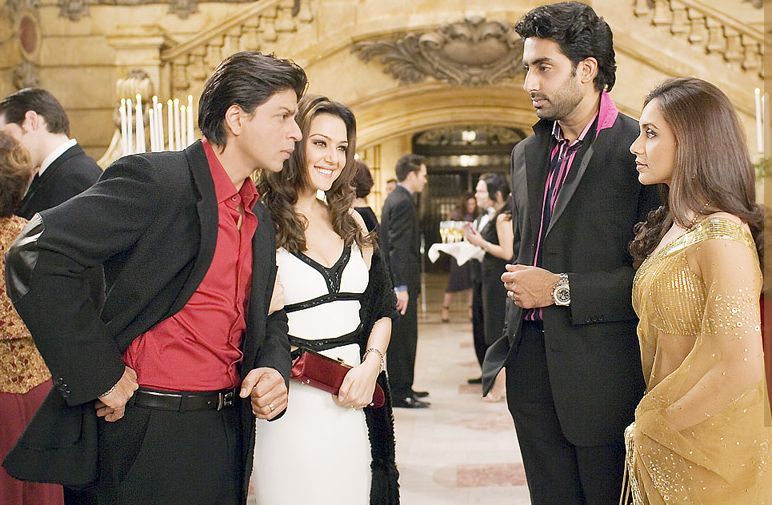
Shah Rukh Khan, Preity Zinta,
Abhishek Bachchan, Rani Mukherji
Kabhi Alvida Naa Kehna (2006)
Image: pinkvilla.com
That Karan Johar gives his audience little credit comes shining through in this nearly 4-hour celluloid magnum disappointus.

Kabhi Alvida Naa Kehna (dubbed KANK by filmi acronym enthusiasts), does nothing but confirm suspicions that Johar fancies himself a Robert Altman but blatanlty lacks the talent or originality of the senior director.
Relying heavily on his almost incestuous connections with Bollywood luvvies, Johar unsurprisingly reeled in an all-star cast with Shah Rukh Khan, Rani Mukherji, Abhishek Bahchan, and Preity Zinta as the leads, and Amitabh Bachchan, Kirron (that's how she's spelling it these days) Kher, and Arjun Rampal as the supporting cast. Resorting to cliched 'spot the star' cheap thrills, Kajol and John Abraham make brief appearances in two all-thumpy no funky songs.

The story centres around the tumultuous relationships of two not-so-happily married couples, Dev Saran (Khan) and his wife Rhea (note the Americanised spelling here) (Zinta), and Rishi (Bachchan Jr.) and Maya Talwar (Mukherji). To make a much-in-need-of-editing film short, all four characters have certain issues that they can not solve within their respective marriages, leading Dev and Maya to seek solace and comfort in each other.

Seems like an opportunity to delve into the darker side of cotton candy romance, doesn't it? Well it is. Sadly, this movie does not deliver on Johar's loudly asserted promise.

Despite the inordinately long time the film has to let the audience engage with the characters, they appear as little more than cardboard cut-outs throughout.

Dev, a disgruntled former soccer star, remains disgruntled, humourless, and unneccessarily mean to his son Arjun; no real explanation is gleaned as to why Maya constantly feels inaduequate despite her husband's overt attempts at love; Rhea's gung-ho 'all work no play' attitude is taken to extremes presenting her as a one-dimensional working mother; and Rishi who is presented as 'child-like' throughout, really does nothing of the sort.
The most unique and believable relationship in the film is the sweet and spunky friendship that develops between Dev's mother, Kamaljit (Kher), and Rishi's father, Sam/Samarjit (Bachchan Sr.). Sadly, the film's treatment of this and the other relationships is as superficial as the glitz in every reel.

The shortcomings are not because the script, largely written by Johar, relies on subtlety--in fact, at times it is so cumbersome that the audience wishes for the opportunity to read between the lines. The script simply does not build on what could have otherwise been a rather meaningful film.

Instead, Johar indiscriminately relies on cliches from his own and mentors Yash and Aditya Chopra's previous celluloid melodramas to weave thin attempts at humour and depth. KANK resembles, in no small measure, a not-so-cheap knock-off of
Silsila with a sleeker look. Slight changes to the central plot and the now requisite shift of scene from Bombay to New York common to every second film these days is all the credit Johar can take.

In fact, since Johar so vehemently tried to ward off accusations of what can only be labelled intellectual/artistic property theft, one wonders why two classic scenes from Silsila were left blatantly unedited from the final cut.

I refer to: (1) the hospital scene in Silsila when Rekha presents Ambitabh Bachchan with a bouquet of red roses: 'Khamosh ho ke bhi phool apne rang or khushboo se bahut kuch keh jaate hain' and (2) watching his wife Rekha dance with Bachchan, Sanjay Kumar says to Jaya Bachchan: 'Aise lagta hai ki angrezon ne dancing ka doosre lagon ki biwiyon ke saath naachne ka achchha bahana hai.'

Both scenes are almost identical in KANK, with Abhishek Bahcchan echoing daddy's words 25 years later in response to a red rose he mistakenly assumes Rani Mukherji brought home for him, and Shah Rukh Khan aping Kumar's words but substituting 'dancing' for parties while Bachchan Jr. obliges Preity Zinta in a PR-do.

Wednesday, June 09, 2010

Back to 'work'

I think the run of some truly mind-numbing films over the last few years took its toll and killed the will to continue with the blog. While the mind-numbing nature of many of the films released over the past four years hasn't changed much, the desire to comment on them has certainly been reignited. Why? I think my anger issues will probably receive a much more enthusiastic response if I comment on the hilarity of the always present white-sari-in-the-rain scenes than on contemplating new ways of using that never-ending piece of fabric for other means.

Sunday, February 26, 2006

Neal 'n' Nikki- yuk 'n' yukky

Tanisha Mukerjee and Uday Chopra
Image: yashrajfilms.com
When is Uday Chopra's daddy dearest finally going to have the strength to burst his 'tiger's' bubble and get him off the screen? 

In yet another attempt to launch the struggling wanna-be star, Yash Chopra's production house, Yash Raj Films, produced Neal 'n' Nikki, relying more on Tanisha Mukerjee's ample cleavage than Chopra Jr's limited 'talent' to draw in the crowds. That Baby Chopra would have been pestering big brother Aditya to produce this all-gloss no momentum film is pretty apparent--the poor man had to rip off his own classic, Dilwale Dulhania Le Jayenge, to massage kid brother's delusions of grandeur.

The story is of the typical boy-meets-hates-loves-girl variety.

Neal (Uday Chopra) is set to marry Sweety from Punjab in 21 days and begs his father for his last singleton days to be bachelor heaven in Vancouver. (Sound suspiciously similar to Simran in DDLJ?) This is where he meets Nikki (Tanisha Mukerjee) and you can fill in the blanks.

Half the length of DDLJ, it follows half the story centring on the coming-of-age road trip (substitute British Columbia for Europe), with definitely less than half the oomph. There's even a scene where they parody the famous Simran running-in-the-sarson-fields scene towards Raj.

Lacking originality in plot, this movie sold itself on two main novelties: (1) that it was shot in BC and (2) it dealt with pre-marital sex. But this is where they went wrong.

Neal 'n' Nikki is not the first or only film to be shot in BC: Aap Ko Pehle Bhi Kahin Dekha Hai, Mohabbat, and Shakti (to name a few) have been there and done that.

As for pre-marital sex,we don't have to look further than Yash Raj Films itself to see that not only is it currently Bollywood flavour of the month (Salaam Namaste) it has had a long and intimate history with Indian cinema (Dhool Ka Phool, Deewar, Silsila).

So what exactly does this film offer?

1. An insight into Indo-Canadians? NO.

The first scene opens with Neal, supposedly born and bred in Canada, describing himself (in English) as a typical 'Indian guy who's never been to India' in the thickest Indian accent you have heard. There's nothing wrong with an Indian accent, but how prey tell, does a Canadian dude from small-town Oliver, BC acquire it when he's never even stepped foot in the pind? Ditto for Nikki.

It raises further questions about authenticity when the two real-life Indo-Canadian extras playing Neal's best friends talk to him with the local Canadian accent (as one would expect). We're left wondering if was Neal raised in a vacuum watching only Mumbaiya Hinglish TV.

Question for the director, Arjun Sablok: What was the point of Uday's blue contacts?


2. A timeless and exquisite love story? NO.

The chemistry between Chopra and Mukerjee could put a damper on a puddle. This is hardly surprising since Nikki's only character development rested on how successively short her skirts could get with each passing scene, and how many bras she could pass off as tops.

The particularly yukky moments came during the excruciatingly long slobbering lip-locks. Aside from the handicaps in their actual kissing technique (maybe some coaching and a box of Kleenex would have helped), given the lack of any real emotional bonding between the characters it reeked of a transparent ploy to rake in an audience. God knows, it had next to nothing else.

3. A showcasing of new and budding talent? HELL NO.

The biggest indictment here is that for the first time in any of his films, Chopra was not the most annoying among the cast. That prize had to be given to Mukerjee hands down.

Openly imitating some of big sister Kajol's tactics, Tanisha embodied all of her annoyances with none of the saving graces. Either that or she played the character of Nikita Bakshi a little too convincingly. I lean heavily towards the former.

A little thought to ponder: isn't it interesting that Uday's 'stardom' is limited to in-house productions by Chopras' chamche? It's telling when the owner and star-director of the self-professed 'number 1 production house in India' won't take his own son in any of his centre stage productions.

If he's not good enough for them, I wish they would stop inflicting these all-style-no-substance hacks on the rest of us.

Thursday, February 23, 2006

Maine Pyaar Kyon Kiya- WHY indeed!

Granted, David Dhawan is not known as a great provider of thought-provoking and symbolic cinema, but in Maine Pyaar Kyon Kiya he fails to meet even his own low standards.

That this three-hour ordeal was nothing more than a paid Khan family vacation to the Maldives and Dubai (with girlfriend Katrina Kaif and brothers Sohail and Arbaaz Khan in tow), was evident as plot was traded for glossy sets and frolics on the beach. You half-expect step-mother Helen to wiggle out from behind a palm tree firmly grasping father Salim's hand. If only.

The 'story'
centres on the philandering ways of a supposedly 'young' 30-something orthopaedic surgeon, Sameer (Salman Khan), whose string of girlfriends are kept at bay by constantly lying that he his married. This works until he falls in love with Sonia (Kaif), and wants to marry her.

Having willingly had an affair with a supposedly married man, Sonia suddenly develops a set of scruples and harasses Sameer (while annoying the viewers) to meet his supposed wife.
Sameer enlists his nurse Naina (Sushmita Sen), who is secretly in love with him, to play said biwi. (Well, of course, what 5' 10" nurse with model looks would not fall for a 5' 4" doctor with a receding hairline who molests his female patients and lies to his girlfriends?)

To make a long, annoying, and predictable story short, the lies escalate until Sameer's staged divorce with Naina is halted by his mother who rides into the courtroom as soon as she steps off her train from Patiala (or some such place) after he delivers the line, 'What do we expect from our wives? That they're like our mothers in the kitchen and our girlfriends in the bedroom'. One wonders if Salman found it easy to slip into this method acting after years of real-life experie
nce...

After an elaborate homecoming of the newly non-divorced couple, a series of Binduesque behaviour is adopted by Naina to make
saasu-maa beg Sameer to get a divorce after all. All the while, Sameer is secretly seeing Sonia who is also being wooed by her neighbour, Pyaare (Sohail Khan).

And yes, you guessed it. There is a jilted-at-the-alter finale (Sonia leaves Sameer for Pyaare) which wouldn't be complete without a stop-the-plane airport scene (Sameer is urged by best friend, Vikaram or Vijay or V-something (Arshad Warsi) to get Naina back).

The airport scene confirmed that the quickly dwindling number of unstolen Hollywood scenes has caused some directors to turn to television. I am speaking of the final episode of
Friends where Phoebe stops Rachel's plane to Paris by scaring people into thinking something was wrong with the 'left magwheel'.

Ditto. Insert Naina for Rachel, Sameer for Ross, and V-something for Phoebe. Of course, why Naina would take the call of V-something at all, a man whom she despised so much that she had to leave the room to wash her hands every time he touched her, remains among this movie's many mysteries.

All the usual disclaimers about Salman Khan's 'acting' apply. He can barely deliver a line without contorting his face, his contrived deep voice squeaks to belie its high pitch, he's bare-chested at least once a reel, wears high-heeled boots to appear taller than both female co-stars, and postures throughout.

Most telling about the quality of this film is that despite all of this, his acting 'ability' out-scrapes Sohail Khan's. Blessed with even fewer looks and talent, Sohail joins Salman in flexing his muscles throughout. Someone should really tell him to stay behind the camera--but then again, perhaps this is why he finances his own films.

Why we are forced to endure a 40-something has-been actor turned fatal hit and run driver, poacher, and woman-beater who displays his steroid induced body for self-propagated voyeurism on the screen, is really the question. Sadly, this film does nothing to counter that.

Sunday, January 08, 2006

Dosti - this film's no friend to cinema

Deol, Dutta, Kapoor, Kumar in Dosti
Image: BBC Shropshire Entertainment website
So Hindi movies have got slicker and sharper than the pitiful efforts churned out in the 80s? Think again.

While Akshay Kumar and Bobby Deol are never going to win serious acting awards, with Kareena Kapoor and Lara Dutta added to the cast, you would think that the end product would be less torturous than the 136 minutes of brutality Dosti turned out to be.

One of the main problems is the film is not sure what it's supposed to be - comedy, romance or family melodrama? Trying to fit in all three fails disastrously.

Subtlety is at a premium from the opening sequences as Karan Thapar (Deol) is neglected preposterously as a child by his busy parents, played by Lilette Dubey and Kiran Kumar. In an early scene, young Karan storms out and kicks his football from their farm, bearing a striking resemblance to a city mansion, towards the Himalayas! He slips down the ravine but is rescued when the ever originally named, Raj Malhotra (Askhay Kumar), appears from nowhere. 

So the two friends become adults in Chandigarh (while the parents haven't aged a day), which the film claims is right next to Gurgaon (in fact hundreds of miles away). In one of the scenes (visibly filmed in Shimla) the number plates are so fake it seems they're painted on planks of cardboard. Despite these glaring issues, there's nothing early on to suggest this will be anything worse than an average flick. When Anjali (Kareena Kapoor) is introduced as Raj's love interest and the playboy Karan pursues Kajal (Lara Dutta), there are even some moments of genuine humour.

But then it all goes wrong. 

Both weddings are called off as hastily as they are arranged. Anjali is married off within hours, and Raj is diagnosed with an incurable bone marrow problem. In his final days, Raj decides to bring Karan's family together and get his marriage with Kajal back on. Achieving this is ridiculously easily.

In quite the farcical finale, we are told there is a cure for Raj's problem but there's no point flying to the US to save him.

Despite seeing his life squeezed out by the minute, Raj frolics away with his doctor at Karan's wedding until an epileptic seizure (is that a symptom of bone marrow disease?) precedes a predictably emotional climax.The final scene sees Karan celebrating his businessman of the year award despite never working a single day.

When you stop drying the tears of laughter streaming from your cheeks, you might go away thinking it's the script and plot which are diseased in this film more than any of the characters.

Monday, January 02, 2006

Shikaar - someone should hunt down Jas Pandher

If you saw Indian Babu and went away safe in the knowledge that it would surely end the career of Jas Pandher after only one film, we have bad news for you!
His father Surinder (owner of Southall-based Himalaya Carpets and Himalaya Palace Cinema, and a one-flop disaster himself in the 60s) has bankrolled a second successive shocker.

Jas Pandher plays Vijay Sanyal, whose bank manager father is murdered at the start of the film by head villain Damania (Danny Denzongpa) and his associates - and not a moment too soon after an abject performance where he struggles to remember his lines!

In the scene where he is shot, the father slumps to the floor, apparently dead. But near the end of the film, when the story is recapped, he is shown staggering back home to reveal the identity of his killer to his son - who then runs off, after his mother has also collapsed and died, leaving his sister stranded.

Or so you think...

Having grown up to become a car thief - while none of the villains aged a single day - Vijay begins his 'shikaar' by enticing his targets to Mussorie where he plans to sell them a hotel he takes over after marrying Madhu (Kanishka).

One by one Tej Sapru, Shweta Menon, Shakti Kapoor, Ashish Vidhyarthi, and Prem Chopra (who plays Nikhil Chopra, 'Son of Prem Chopra' - the joke wears thin after one mention) are knocked off by a mysterious killer - who looks uncannily like Vijay.

It looks a straightforward case for the amnesiac cop played by Raj Babbar - but lo and behold the climax reveals the killer to be his sister, played by Saadhika.

As you may have gathered, the plot has gaping holes in it, while the script is laughable. The soundtrack is lame and songs are erratically woven in to fill the huge vacuum.

Pandher's acting is non-existant - he rarely takes off his sunglasses in the movie, an attempt to hide his expressionless face, while he tilts his head from side to side and raises his eyebrows while 'delivering' his lines.

Apart from the guy who plays his father - who could very well be his off-screen dad - the other actors aren't too bad. In fact you have to feel for poor old Danny, who must be wondering what he let himself in for.

It's not the worst film we've ever seen - but it's not far off - and hopefully this is the end of Jas Pandher's career.

You could say it got as a good as it could for him when he starred in a commercial for his dad's shop and, arms outstretched, uttered the immortal line: 'We sell carpets, sofas, tables, chairs and furniture too!'

Monday, November 28, 2005

Hollybolly - hit or miss?

Have you seen a truly dreadful Hollywood or Bollywood film and been left in stitches by the sheer incompetence of it?

We regularly witness such shambles and there is a perverse pleasure to be gained from sitting through anything from 1.5 to 4 hours of it!

We will highlight particularly dire displays of cinematic incompetence here and invite you to add your comments.